
Mast Cell Tumors in Dogs: Signs, Diagnosis, Life Expectancy, and Vet Care

Finding out that your canine best friend has a mast cell tumor can be rather devastating. Besides requiring prompt veterinary attention, delaying care for mast cell tumors in dogs can also potentially lead to other serious health issues sooner or later.
Although mast cell tumors commonly affect the skin, they can also have an impact on other parts of your dog's body like the spleen, liver, as well as local lymph nodes. And the whole clinical outcome significantly depends on the crucial steps you take during its early stages with your veterinary team.
This is the reason why we've put together this blog post to get you in on the important things you need to know about skin tumors affecting mast cells in dogs. We will discuss possible risk factors, the symptoms to keep an eye on, how this health problem is diagnosed, life expectancy ranges, and the care options veterinarians commonly discuss.
We will also cover supportive wellness that can sit alongside conventional veterinary care. For everyday supportive habits after diagnosis, see also our companion guide mast cell tumors in dogs: warning signs, diagnosis, and supportive care. Additionally, our guide to supporting dogs through cancer care contains broader information about cancers affecting dogs.
What Are Mast Cell Tumors In Dogs?

Mast cell tumors in dogs affect the "mast cells," a type of white blood cell the body uses for allergy response. Apart from being deemed as the most common type of skin tumor in canines, it is also rather tricky to accurately predict biological behavior when it comes to this wellness problem.
And just to emphasize as early as now, according to veterinary medicine studies, a canine pet's mast cell tumor makes up around 20% of all diagnosed cases. Did you know that mast cells have a key role in dealing with allergic reactions in a dog's body, too?
What's worrying about this health issue is that tumor cells of this type can either lead to low-grade tumors (less aggressive and won't usually spread to other parts of the body) or high-grade tumors (more aggressive and typically spread to different areas).
Where mast cell tumors can appear
Given that mast cell tumors are the most common skin tumors in dogs, they can also affect the lymph nodes, spleen, liver, intestine, and bone marrow. Additionally, one of the significant effects of canine cutaneous mast cell tumors is enlarged lymph nodes.
Is There a Difference Between a Primary Tumor and Secondary Skin Tumors?

The short answer is yes.
A primary tumor is the "first" that manifests in a dog's body as a skin mass. It turns into a "secondary" tumor as soon as it spreads to another part of your pet's system, which is also referred to as a documented metastasis.
Moreover, a secondary tumor usually targets the internal organs and the regional lymph node in most cases depending on the tumor location. In this situation, there is already the presence of multiple tumors.
Low-grade tumor vs. high-grade tumor
While mast cell tumors vary, they are typically made up of abnormal masses of tissues or growths. They may also be in the form of low-grade tumors or high-grade tumors. The higher the grade, the higher the risk for more aggressive behavior.
Example: Grade I tumors do not usually behave as aggressively as Grade II tumors and Grade III tumors. It is typically high-grade tumors that carry a higher risk of spread. These grades may also be poorly differentiated, intermediately differentiated, as well as well-differentiated.
Tumor vs. cancer
It is important to take note that this health issue can also lead to multiple skin tumors and will usually require a tissue sample for proper verification. (We will discuss how tumors are typically diagnosed in just a bit.)
On the other hand, cancer pertains to the proliferation of abnormal cells or cancer cells; it may only involve a few cells in some cases. Regardless if it is a tumor or cancer, you should immediately schedule a consultation with your veterinarian or a veterinary oncologist to evaluate the problem as soon as possible.
Causes or Risk Factors of Dog Mast Cell Tumors

Despite the strides in modern veterinary medicine, there is still no known specific cause as regards mast cell tumors in dogs.
Heredity may be a link
However, we know that there are certain genetic or hereditary factors involved because some breeds are more commonly affected, such as Boston Terriers, Labrador Retrievers and Boxers, among others. Mast cell tumors can also target small breeds like Boston Terriers.
As with many cancers, older dogs are diagnosed with mast cell tumors more frequently.
Clinical Signs of Canine Mast Cell Tumors

If a mast cell tumor is affecting internal organs, or the chemicals in the cells are being released in the body, you might see these symptoms:
-
Decreased appetite and weight loss
-
Vomiting or diarrhea
-
Lethargy and loss of energy
-
Collapse
Mast cell tumors on the skin can't be diagnosed just by looking at them, because they don't always look the same. You might notice other signs such as a lump on your pup's skin, a bump underneath the skin, or a red, ulcer-looking growth. Sometimes these lumps can change in size, getting larger and smaller with time. Sudden swelling after the lump is handled, sometimes called Darier's sign, can happen when histamine is released from the mass.
Remember that not all lumps or bumps found on or under your pet's skin are cancerous! Also, not all lumps or bumps that don't look dangerous are benign (not cancerous). If you've found something unusual on your pet's skin, or in their behavior, make sure to get it checked out right away so your vet can determine if it's serious or not.
How are Canine Mast Cell Tumors Diagnosed?
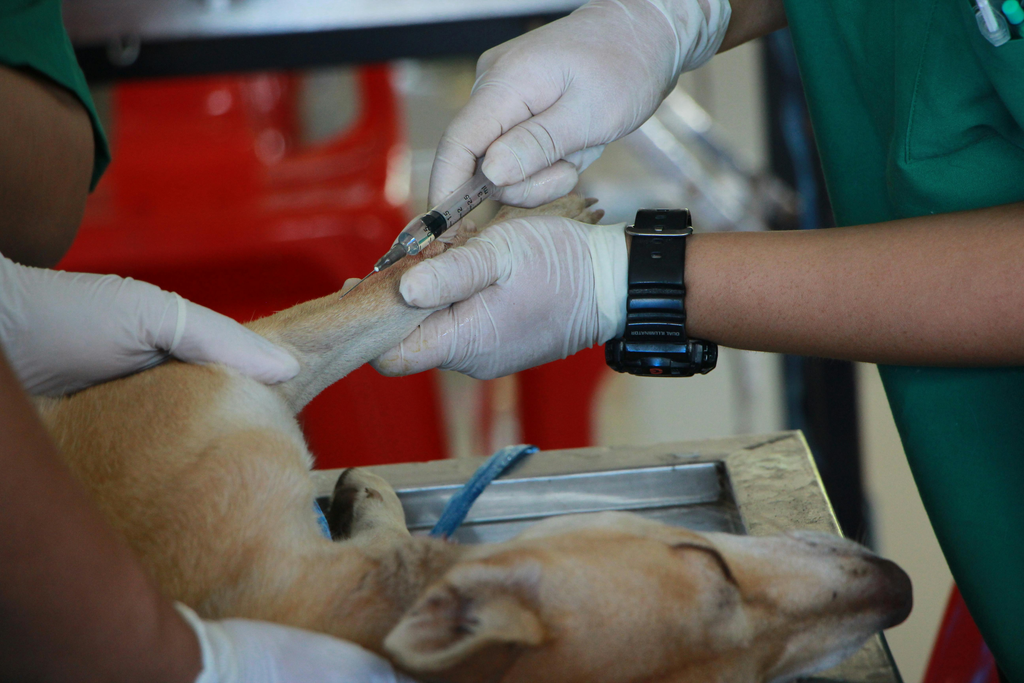
The most common procedures used with regard to the diagnosis of mast cell tumors are biopsy and fine needle aspiration (FNA).
Difference between biopsy and FNA
While both may involve collecting tissue to check for the presence of a tumor, regular biopsy typically uses a wider needle compared to that used in fine needle aspiration.
Besides resorting to tissue biopsy or having to fine needle aspirate a suspicious lump, other procedures utilized for diagnosing mast cell tumors in dogs also include X-ray, computerized tomography (CT) scan, abdominal ultrasound, positron emission tomography (PET) scanning, and magnetic resonance imaging (MRI), among others, which are rather similar to human medicine.
We'd just like to reiterate the importance of determining if your dog has a mast cell tumor so your veterinary team can establish a care plan. A higher tumor grade may already require more aggressive local therapy combined with a receptor tyrosine kinase inhibitor or multiple drugs in some cases.
It's also not uncommon to hear a "guarded prognosis" from your vet if a mast cell tumor has been ignored or overlooked for a long time.
What is the Life Expectancy of a Dog With a Mast Cell Tumor?

How long can a dog live with a mast cell tumor? Mast cell tumors in dogs have different "grades," or levels of severity, and the life expectancy can vary from as little as a few months (with an average of 4 to 6 months) in a Grade III tumor, to years with a Grade I tumor.
When a mast cell tumor on the skin is bumped, moved, or agitated, this can cause the chemicals inside to be released and spread throughout the body, causing problems for your pup. So try not to feel it repeatedly, and discourage your dog from licking, biting, or scratching it to reduce the chances of this happening.
Veterinary Care Options for Mast Cell Tumors in Dogs
Most veterinary teams will discuss surgical removal (often with appropriate margins), systemic chemotherapy, radiation therapy, and the use of tyrosine kinase inhibitors, among other options, when mast cell tumors are concerned. These medical strategies belong with your veterinarian or veterinary oncologist.
Like many cancer therapies, conventional options can involve side effects for some dogs. Your veterinary team will weigh benefits and risks for your dog's specific grade, location, and staging results.
Supportive nutrition and wellness products discussed elsewhere on our site are meant to sit alongside that veterinary plan, not as remedies that cure, eliminate, or shrink mast cell tumors. For a focused look at everyday supportive habits, see our companion post on warning signs, diagnosis, and supportive care for mast cell tumors.
Natural immune support alongside veterinary care


Many pet parents also look for natural options that can sit alongside conventional veterinary care. If you are looking for a natural product for daily wellness support, you can learn more about PiptoPet.
PiptoPet is a birch-polypore formula (Fomitopsis betulina) designed to support a healthy immune response in cats and dogs. It is meant to complement your veterinarian's care plan, not replace diagnosis, surgery, radiation, chemotherapy, or other veterinary treatment for mast cell tumors. Talk with your veterinarian before adding anything new to your dog's routine.
About the author
14 comments




Thank you for your comment and I’m sorry to hear about your poor dog’s diagnosis. We will be emailing you with recommended natural solutions that can help support your dog during this difficult time. In general, there is no need to stop other treatments while giving our products, we simply do recommend to space them out from our products 30mins or more for best results in the body. We will be sure to provide all the information you need in our email to you.
ZUMALKA
Our 12 year old dog was diagnosed with mast cell. His donor grew from the corner of his eye, was removed but came back aggressively. It was deemed inoperable because of its location, spreading to his eye lid as well. We opted to treat naturally and over the counter. It has also enlarged the local lymph nodes significantly and growths on his cheek. He still eats well and seems to be comfortable, still same personality. If I get the recommended treatment plan from y’all do I stop giving his other meds? Benadryl, prednisone, vetoryl (for cushings), heart burn otc, plus turkey tail, bee pollen, quercetin, reisin mushroom, lignans and melatonin blend at night, glucosamine chews. We make homemade diy dog food and throw in fresh blueberries, apples, carrots.
I’m sorry to hear that, Cheryl. I sent you a private email so that we can get the homeopath to personalize a treatment for your pet. We hope to hear back from you soon !
My 4.5 yr old has a mast cell cancer on her leg, don’t know the grade yet. She’s had it for a few months. She’s scheduled for surgery, but is there another option? I just lost a dog 7 months ago….I can’t go through this again. Thank you
Hi Ellie! So sorry to hear about your dog’s diagnosis! :( I will reach out by email to see how best we can help you and your dog through this difficult time.
Leave a comment